


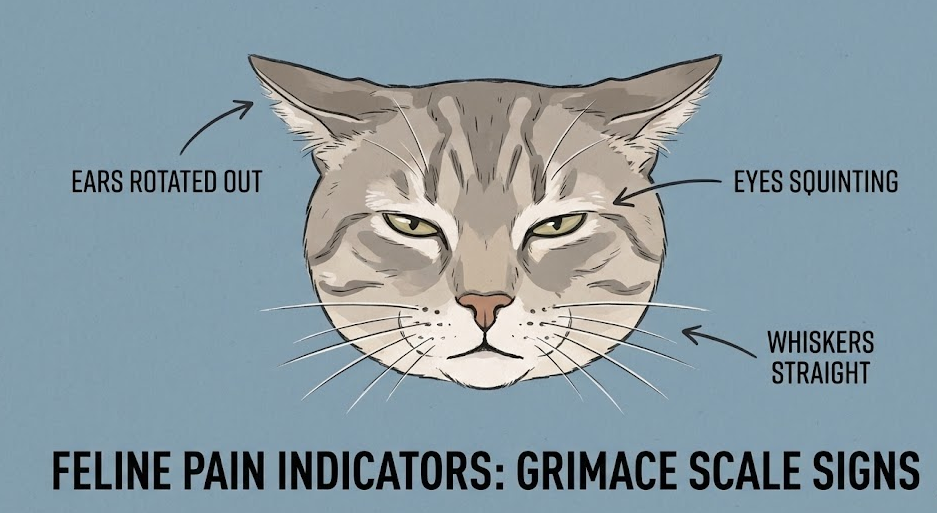
Why is it difficult to tell if your cat is in pain? The cat is a predator, but in nature it is also prey. Out of survival instinct, he tends to mask any signs of weakness or pain (“silent suffering”) so as not to appear vulnerable. When a cat manifests obvious pain (moaning, lameness), the suffering is already in an advanced stage. For this reason, in cancer patients, pain therapy (palliation) must be started early, often before the striking symptoms.
La Feline Grimace Scale: Reading the pain on the muzzle
Veterinarians use a visual scale based on 3 parameters to assess acute and chronic pain:
- Position of the Ears: If they are rotated outward or flattened, they indicate discomfort.
- Eyes (Eyelids Tightened): Squinting eyes are a sign of pain, not sleep.
- Mustache (Vibrissa) position: If they are straight forward or far back (near the nose), instead of soft and curved, there is tension.
Other signs of chronic cancer pain
- Insulation: It hides under beds or wardrobes.
- Grooming: Matted, dull, or greasy fur (the cat stops washing).
- Contracted sphinx position: He is crouched but tense, with his head down, not relaxed on his side.
- Sudden aggression: Blows or scratches if touched in specific places.
- Lack of appetite: He approaches the bowl but does not eat (nausea or pain).
Drugs and Natural Remedies for Pain Therapy
Allopathic drugs (Under veterinary prescription):
- NSAIDs (anti-inflammatories): (e.g. Meloxicam). Used with caution in cats due to renal toxicity.
- Gabapentin: for neuropathic and chronic pain, it also has a calming effect.
- Opioids (Buprenorphine/Tramadol): Essential for moderate-to-severe pain, often used sublingually or by injection.
Natural Remedies and Supportive Supplements:
- PEA (Palmitoylethanolamide): An exceptional natural lipid modulator for chronic and inflammatory pain, with no side effects.
- CBD (Cannabidiol): Hemp oil specific for animals, useful for relaxing and raising the pain threshold.
- Arnica Compositum: For pain from trauma or acute inflammation.
- Omega-3: Systemic anti-inflammatory action.
Cancer in cats In this article we look at the treatments and pain management in the cancer cat. If in humans, we have dealt with oncological diseases, we know how difficult it can be to counteract pain and suffering, no matter the type of cancer, it causes not only suffering, but also other negative effects.
Frequently Asked Questions about Palliation
What can I give my cat for cancer pain?
Never give human drugs! See your vet for a prescription for safe molecules such as Gabapentin or Buprenorphine. As a natural medium, PEA is very safe.
Does the cat purr even if it is in pain?
Yes. The “therapeutic purr” (self-soothing) is used by the cat to calm down. A cat that purrs incessantly while hidden or injured may experience a lot of pain, not pleasure.
How to understand if it is time to let him go?
Evaluate the “Quality of Life”. If your cat is no longer eating, grooming, having trouble breathing, and pain medication is no longer working, talk to your veterinarian about final palliative care or euthanasia to avoid unnecessary suffering.
“Animals suffer like us, perhaps they have greater tolerability but in the end there are no differences. Pain contributes significantly to the development of loss of appetite, weight loss, reduced mobility, depression.”
Pain in cancer cats
The pain caused by cancer in cats negatively affects the animal’s quality of life, and symptomatic analgesic therapy certainly improves supportive care. Before treating pain in the cancer cat, it is necessary to have a basic knowledge of the pathophysiology of cancer; Pain, as we will see, can be caused directly by the tumor and is classified as pathological pain, or caused and associated with edema, ascites, intestinal obstruction, infection and finally caused by diagnostic and therapeutic interventions.
Cancer in cats
Different types of pain in cancer cats. Pain in cats and animals in general can be divided into three categories
- The pain is caused directly by the tumor and is classified as pathological pain: bone metastases, nerve compression and soft tissue infiltration are the result of a neoplastic pathology.
- Pain is associated with edema, ascites, intestinal obstruction, infection.
- Pain is caused by therapeutic interventions, post-operative pain, radiation, tissue necrosis and all those pains caused directly by the methods used to treat various types of cancer.
Pain negatively affects the animal’s quality of life, symptomatic analgesic therapy certainly improves supportive care. Before treating pain in cats with cancer , it is necessary to have a basic understanding of the pathophysiology of cancer.
Painkiller treatment is chosen based on the intensity of the pain and includes the following categories of medications:
- Nonsteroidal anti-inflammatory drugs
- Codeine and tramadol (mild opioids)
- Morphine, methadone (for severe pain)
- Fentanyl drug very powerful for controlling pain in veterinary oncology
Opioids are considered the mainstay of pain therapy in both human oncology and veterinary oncology, side effects occur at high dosages and with long-term use, they are still tolerable, they include: constipation, bradycardia, respiratory changes, vomiting and histamine release.
Cortisone cat tumor
Corticosteroids have a milder analgesic effect and are often prescribed to treat pain in cats with cancer and should not be given together with NSAIDs.
The development of pain syndrome in cats with cancer is associated with several points:
1. Pain associated with underlying disease: As the tumor grows, it compresses the surrounding vessels and nerves, causing chronic pain response.
2. Pain associated with syndromes of the underlying disease: For example, against the background of the development of mastocytoma – a tumor of mast cells, hemorrhagic colitis (inflammation of the large intestine) often occurs.
3. Pain associated with treatment such as surgery or chemotherapy
4. The use of chemotherapy drugs can lead to complications: gastritis, pancreatitis, colitis, which are accompanied by pain.
Complementary therapies and pain management in cancer cats
- Acupuncture
- Massages
- Reiki
- Tens
- Laser therapy
- Magnetotherapy
- Chiropractic
Let’s recap: Pain in the case of cancer in cats is divided into
- Acute
- Chronic
- Mild
- Moderate
- Severe
It can be caused
- From cancer itself
- Metastasis
- From diagnostic procedures (e.g. biopsy)
- From paraneoplastic syndrome
- From chemotherapy, radiotherapy, or invasive surgery
- Medications
Radiation therapy causes inflammation of the mouth, skin, eyes, or intestines
Chemotherapy causes intestinal inflammation
Cancer in cats: The most painful tumors
- Bone tumors
- Brain tumors
- Stomach tumors
- Breast cancer
- Cancers of the mouth, nose, throat
Therapeutic complications and pain management in cancer cats
Radiation burns
The side effects of radiotherapy are usually burns of tissues and mucous membranes, to treat the pain associated with radiotherapy the following are used: oral opioids, sucralfate, lidocaine, TCM (Traditional Chinese Medicine) and acupuncture.
Tissue necrosis
Many anti-neoplastic agents cause significant tissue injury. Treatment options include local injections of corticosteroids, oral opioids and NSAIDs, surgical tissue reconstruction.
Gastrointestinal pain
Pain associated with the GI tract in the presence of cancer is associated with vomiting, diarrhea, or pancreatitis. For vomiting or nausea, antiemetics and lidocaine are used to control pain in cats with pancreatitis.
Biopsy-related pain
Endoscopic biopsies, surgical biopsies, and tissue biopsies always cause pain. Anesthetics, NSAIDs and opioids are used.
HomeCare Tips Pain Control
At home it is important to control pain by following the veterinarian’s instructions, the animal must stay in quiet places and receive adequate nutrition and nutrition, specific in the case of neoplasms: nutrition and cancer in cats Natural remedies and cures to relieve pain in cats with cancer (prescription by the veterinarian)
- Devil’s Claw
- Turmeric
- Arnica
- Ginger
- CBD OIL
Recognizing when your cat is sick
Cats for a purely defensive matter are very good at hiding pain, just think that in nature a suffering or weak animal is an easy prey. The signs that should alarm us
- Abnormal posture
- Change in behavior
- Change in appetite
- Sudden reactions when we try to touch it
- Sudden assault
- Increased heart rate
- Asthma Bronchitis in cats
- Continuous crying or meowing, vocalizations
- Urinating or defecating in unusual places
Disclaimer: The Contents Are For Informational Purposes Only And Under No Circumstances Can They Constitute A Prescription Of A Treatment Or Substitute For A Specialist Visit Or Direct Relationship With Your Veterinarian/Doctor. All information reported here is derived from bibliographic sources, personal experiences and clinical studies in the public domain. All information on special diets and dietary supplements for pets is for informational purposes. This information serves as a general guideline, cannot be applied to all pets or considered as an alternative to professional advice. These pages include “Homeopathic preparations of non-scientifically validated efficacy and without approved therapeutic indications. The products are not intended as a substitute for a varied and balanced diet and must be used as part of a healthy lifestyle. Disclaimer and terms

