

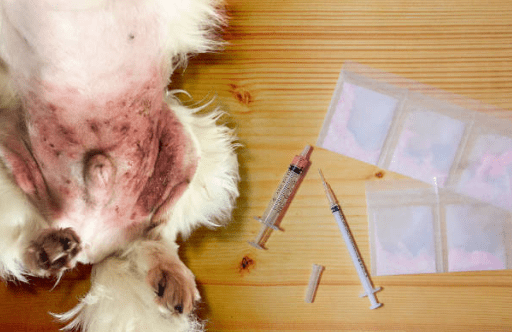
To treat dermatitis in dogs naturally, a 4-step approach is necessary: restore the skin barrier with ceramides, balance the immune system (Th1/Th2 ratio), integrate specific probiotics, and drain toxins with homotoxicological remedies such as Galium-Heel. I’ll explain my protocol!!
4 Strategic Goals to Defeat Canine Dermatitis
Dermatitis is not just a skin problem, but a sign of an internal imbalance. Here is the advanced protocol for deep healing.
Goal 1: Restoration of the Skin Barrier with Ceramides
The first step is to repair the protective “wall” of the skin. When the barrier is compromised, allergens penetrate easily, binding to IgE (Immunoglobulin E) and activating mast cells, which are responsible for itching. Improving the skin barrier defect with ceramides
- What to do: Use products containing ceramides, hyaluronic acid and chelated zinc to seal the epidermis.
Goal 2: Balance the Immune Response (Th1/Th2)
In allergic diseases, the Th2 (pro-inflammatory) response prevails, which increases the production of interleukins (IL-4, IL-5, IL-6). The goal is to stimulate the Th1 response to reduce hypersensitivity.
- Scientific Focus: Langerhans cells play a pivotal role. Modulating their activity means reducing the abnormal reaction to environmental allergens.
Goal 3: Care of the Skin and Intestinal Microbiota
NGS (Next Generation Sequencing) research has confirmed that bacterial and fungal dysbiosis is the primary cause of recurrences.
- Solution: It is not enough to take care of the outside. It is essential to integrate specific probiotics and synbiotics to recolonize the skin and intestine with beneficial bacteria.
Goal 4: Natural Antihistamines and PEA
For the control of itching without side effects, modern nutraceuticals offer powerful alternatives to traditional drugs:
- Palmitoylethanolamide (PEA): A natural aliamide that modulates mast cell reactivity. Ideal for atopic dermatitis and eosinophilic granuloma complex.
- Zinc and Biotin: Essential for collagen synthesis and the shine of the coat.
Table of Suggested Remedies (Pet-Food Supplementation)
| Remedy | Main Function | Recommended Use |
| PEA (Redonyl/Retopix) | Anti-itch and anti-inflammatory | Acute and chronic phase |
| Zinc | Protection against free radicals | Maintaining elasticity |
| Biotin (Vit. H) | Keratin synthesis and absorption of fatty acids | Welfare of the coat |
| Omega-3 | Reduction of systemic inflammation | Prevention of recurrence |
PEA is a natural painkiller and anti-inflammatory The products that contain PEA are Redonyl and Retopix
Useful supplements to avoid relapses and fight inflammation
Zinc chelated amino acid
Biotin – water-soluble vitamin essential for the skin and the well-being of the dog’s coat, its intake allows you to better assimilate gamma linoleic acid Essential Fatty Acids (only as a prevention and against recurrences)
Zinc: protects cells from deterioration caused by the activity of Free Radicals (oxidative stress) plays a fundamental role in maintaining healthy, elastic and hydrated skin and a strong and shiny coat. (integration required)
Drainage of the extracellular matrix with the homeopathic remedy Galium Heel or with Meristemo 6. The products of the Meristemo line represent a new concept of phytopreparation according to modern phytotherapy.
Through the pages of this Blog you have learned a preview of what are my favorite homotoxicological remedies: IGEAKOS which I have been using for several years for the treatment of various pathologies in cats and dogs.
The SIN 27 IGEAKOS remedy is indicated, both in acute phases and in chronic symptoms! It is characterized by an anti-inflammatory, anti-infective, anti-allergic and skin purifying action. Another preparation that helps in the detoxification and drainage process is the D.O.E. KIT (Igeakos).
Toxin Drainage: Cleansing the Extracellular Matrix
The skin is an excretory organ: if the liver and kidneys are overloaded, toxins exit the skin causing eczema and dermatitis.
Homotoxicological and Phytotherapeutic Remedies
- Galium-Heel: The remedy of choice for the drainage of the extracellular matrix. It promotes tissue cleaning and waste elimination.
- SIN 27 (Igeakos): A fundamental complex with anti-inflammatory and anti-allergic skin action, useful in both acute and chronic phases.
- Meristemo 6: A new generation phytopreparation that optimizes the emunctory activity of the skin and corrects the predisposition to eczema and psoriasis.
The Th1/Th2 Immune Balance in Canine Atopic Dermatitis
In the presence of dermatitis, the dog’s immune system undergoes a deviation of the immune balance. In allergic diseases, in fact, the Th2-type inflammatory response prevails, which triggers a chain reaction mediated by IgE (Immunoglobulin E).
The role of Interleukins and Lymphocytes
The overactivity of Th2 lymphocytes stimulates an excessive production of inflammatory mediators called interleukins:
- IL-3 and IL-4: They push B cells to produce IgE, the main allergic antibodies.
- IL-5: Present in massive doses in atopic and asthmatic subjects.
- IL-6: It feeds the chronic inflammatory state.
To counteract this imbalance, holistic medicine and immunology aim to stimulate a response mediated by Th1 lymphocytes. An efficient Th1 response reduces allergic hypersensitivity by modulating the reactivity of cells involved in dermatitis, such as T lymphocytes, eosinophils, keratinocytes, and endothelial cells.
Langerhans cells: The guardians of the skin
Langerhans cells are dendritic cells located in the epidermis with a pivotal role: they act as “sentinels” that present the antigen to T lymphocytes. Proper regulation of these cells is essential to interrupt the incorrect immune reaction to harmless substances (allergens).
Immune System Regulation Strategies
Is it possible to intervene on the root causes of dermatitis? The answer of modern integrated immunology is Yes. Here are the three pillars of modulation:
- Correction of Interleukins: It is possible to regulate the production of cytokines through the use of specific homotoxicological and phytotherapeutic complexes (such as Perilla or Ribes Nigrum).
- Th1/Th2 Rebalancing: Through micro-immunotherapy and the integration of targeted probiotics, the immune response can be “reprogrammed” towards a Th1 structure, reducing atopy.
- Modulation of the allergic response: The goal is not to suppress the immune system (as cortisone does), but to educate it not to react abnormally to external allergens.
The Skin Microbiota: The Role of Dysbiosis in Dermatitis
Just like the intestine, the dog’s skin is also inhabited by a complex community of microorganisms (bacteria, fungi and yeasts) known as the skin microbiota. When this ecosystem loses its balance, dysbiosis occurs, a condition closely associated with the onset and worsening of inflammatory diseases.
Scientific evidence: The NGS study
To understand the impact of microbial flora on the health of allergic animals, cutting-edge studies have been conducted published in the prestigious journal Veterinary Dermatology. Researchers from Texas A&M University and the University of Minnesota analyzed the distribution of microbiota in humans, dogs, and cats using next-generation sequencing (NGS) technologies.
The results revealed crucial data:
- Bacterial and Fungal Dysbiosis: In individuals with dermatitis, microbial diversity decreases dramatically, leaving room for opportunistic pathogens (such as Staphylococcus pseudintermedius or Malassezia).
- Species-Specific Connection: Although each species has a unique flora, the mechanism by which dysbiosis fuels inflammation is common.
- Predominant role: The imbalance of the microbiota is not only a consequence, but a factor that plays a predominant role in the maintenance of atopic dermatitis.
The importance of Probiotic supplementation
In light of these findings, the use of specific probiotics for the treatment of dermatitis (both common and atopic) is no longer an option, but a therapeutic necessity. Regularly supplementing probiotics helps to:
- Restore microbial biodiversity on the skin.
- Strengthen the skin’s immune defenses.
- Reduce colonization by harmful bacteria that cause itching and secondary infections.
In this article the strains I have studied and that I recommend!
Natural Antihistamines from Homeopathy to Phytotherapy: The Remedies
FAQ – Frequently Asked Questions about Dermatitis in Dogs
Answer: Atopic dermatitis is caused by an imbalance in the immune balance, where the Th2 inflammatory response prevails. This imbalance leads to excessive production of IgE (Immunoglobulin E) which activates mast cells, triggering intense itching and compromising the skin barrier.
Answer: PEA is a natural aliamide that acts as a powerful anti-inflammatory and anti-itch with no side effects. It works by modulating mast cell reactivity, reducing erythema and alopecia. It is particularly effective in the treatment of eosinophilic granuloma complex and chronic dermatitis.
Answer: The skin is an excretory organ: if the liver and kidneys are overloaded, toxins accumulate in the extracellular matrix and are expelled through the skin, causing eczema and dermatitis. Remedies such as Galium-Heel promote deep drainage of tissues, cleansing the body from the inside.
Answer: Probiotics fight skin and intestinal dysbiosis, i.e. the imbalance of the microbiota. Technologies such as NGS sequencing have shown that restoring beneficial bacteria such as the Lactobacillus rhamnosus it helps shift the immune response towards the Th1 profile, reducing sensitivity to allergens.
Answer: Yes, it is possible to manage dermatitis by reducing or eliminating cortisone by modulating the Th1/Th2 immune response. The use of natural anti-inflammatories such as PEA (Palmitoylethanolamide), combined with deep homotoxicological drainage, allows itching to be controlled by acting on the causes and not just on the symptoms.
Answer: An industrial diet rich in additives and preservatives can cause an accumulation of toxins that the skin struggles to eliminate. Switch to a natural diet and supplement key nutrients such as Zinc and Biotin It helps strengthen the skin barrier, keeping the skin hydrated and less reactive to allergens.
Answer: Langerhans cells act as sentinels of the skin: their job is to present the antigen to T lymphocytes to activate the immune response. Through advanced herbal medicine and immunomodulation, it is possible to regulate these cells to break the cycle of hypersensitivity and excessive immune reactivity typical of atopic dogs.
© Copyright – This article is the property of the Elicats.com site – the author prohibits its reproduction and copying without explicit authorization – the information is indicative, the result of studies and personal experiences – Article published 2021 – Revised 2026


