

While Milk Thistle acts as a powerful hepatoprotective “scavenger” by stimulating bile (cholagogue action), Desmodium is an epatori-generating “architect” that repairs damaged cells without stressing the gallbladder. Desmodium is superior in case of viral hepatitis, allergies and when it is necessary to avoid intense biliary stimulation
In the panorama of functional veterinary phytotherapy, the liver is not only considered a filter organ, but the metabolic center of the body’s homeostasis. When we are faced with liver dysfunction (increase in ALT/AST/ALP), the choice between Desmodium (Desmodium adscendens) and Milk Thistle (Silybum marianum) is not interchangeable, but depends on the biological mechanism we want to activate: protection or regeneration.
Desmodium (Desmodium adscendens): the cell regenerator
Known as the “African Queen of the Liver” (Family Fabaceae), Desmodium works on a deep level of liver structure.
Bio-functional mechanism of action
Unlike other remedies, Desmodium contains D-pinitol, vitexin, and isovitexin. These active ingredients work by stabilizing the cell membrane of hepatocytes, preventing necrosis and reducing transaminases in the circulation.
- Epatorigenerator: It not only protects, but accelerates cell mitosis to repair serious damage (e.g. from chemotherapy drugs or acute intoxication).
- Anti-allergic action (Th2 modulation): It inhibits the action of histamine and reduces smooth muscle contraction (bronchodilator effect). It is the remedy of choice for dogs and cats with feline asthma or food allergies concomitant with liver stress.
- Absence of Cholagogue Action: A crucial point: Desmodium does NOT stimulate the production or excretion of bile. This makes it safe even in acute or suspected obstructions of the biliary tract, where stimulating the gallbladder could be dangerous.
Milk thistle (Silybum marianum): the detox protector
Belonging to the Asteraceae (or Composite) family, it is the pillar of European liver medicine.
Mechanism of Action: Silymarin and Glutathione
The active complex, Silymarin (composed mainly of Silybin), acts by armouring the membrane receptors of the hepatocyte against toxins.
- Hepatoprotector and Antioxidant: It increases the levels of intracellular Glutathione , the body’s most powerful antioxidant, which is essential for fighting oxidative stress.
- Choleretic and Cholagogue Effect: It stimulates the synthesis and excretion of bile. This promotes the digestion of fats and fights biliary stasis (“biliary sludge”), but requires caution if there are obstructive stones.
- Beware of Allergies: Being an Asteraceous, it can trigger reactions in subjects allergic to this family of plants, unlike Desmodium.
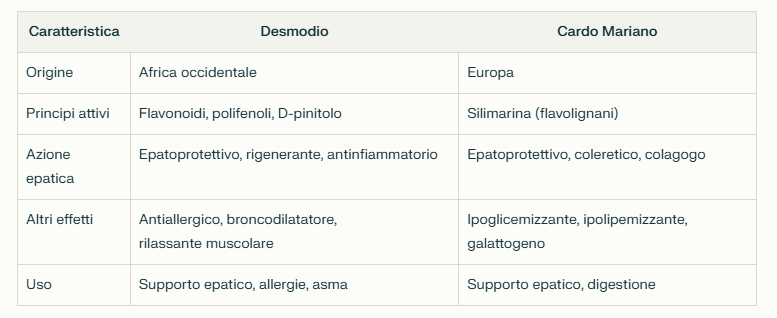
Comparison table: Desmodium vs Milk Thistle
- Desmodium (Desmodium adscendens) is a plant native to West Africa, belonging to the Fabaceae family, known as the “African queen of the liver”.
- Milk thistle (Silybum marianum) is a plant of the Asteraceae family, widespread in Europe and traditionally used for liver health.
| Feature | Desmodium (Desmodium adscendens) | Milk thistle (Silybum marianum) |
| Primary Action | Epatorigenerator (Repairs the damage) | Hepatoprotector (Shield against toxins) |
| Effect on Bile | Neutral (Does not strain the gallbladder) | Cholagogue/Choleretic (Stimulates bile) |
| Active ingredients | Vitexin, D-pinitol, Alkaloids | Silymarin, Silybin |
| Allergy Management | Anti-allergic (Reduces histamine) | Potential allergen (Asteraceae) |
| Top Directions | Viral hepatitis, Severe damage, Asthma, Allergies | Steatosis, Preventive Detox, Biliary Stasis |
| Extra Effects | Bronchodilator, Muscle relaxant | Galactogen (Milk), Lipid-Lowering |
Functional Protocols: When to choose one or the other?
1. The Allergic Dog or Dog with Acute Hepatitis
If the patient has skyrocketing liver values (elevated cytolysis) or suffers from atopy/asthma, Desmodium is the first choice. Its ability to modulate the inflammatory response without overloading the digestive work (bile) allows for faster recovery of homeostasis.
2. Metabolic and Detox Support
For seasonal purification cycles, in obese animals with hepatic steatosis (fatty liver) or dyslipidemia, Milk Thistle is excellent for its ability to mobilize fats and stimulate bile flow, while also improving intestinal digestion.
3. Phytotherapeutic synergy
In many advanced veterinary supplements, the two plants are combined (often with Turmeric or Artichoke). This combination is useful in chronic phases, but in the acute phase or in hypersensitive subjects, the use of Desmodium monotherapy is often the safest and most effective strategy.
Clinical Note:
- Milk thistle: Beware of subjects allergic to Composite.
- Desmodium: Safe, does not cause allergies, ideal when you do not want to stimulate the gallbladder.
Answer: The key difference is in the mechanism: Desmodium is a Epatorigenerator which repairs cells without stimulating bile (ideal in acute phases). The Milk Thistle is a Hepatoprotector which stimulates the production of bile (cholagogue action) and protects against toxins, but should be used with caution in biliary obstructions.
Answer: We must be careful. The Milk Thistle belongs to the family of Asteraceae (such as daisies and ragweed) and can cause reactions in susceptible individuals. In these cases, the Desmodio It is the perfect alternative because it is hypoallergenic and has natural antihistamine properties.
Answer: Desmodium is preferable when there is severe liver damage with very high values (transaminases), in the case of viral hepatitis or if the cat also suffers from Feline asthma, thanks to its bronchodilator and anti-inflammatory action that does not strain digestion.
Answer: Yes, they are often found in synergy in veterinary supplements to cover both the protection and regeneration phases. However, in the acute phase or if there is a suspicion of gallstones, it is best to consult the veterinarian who may prescribe only Desmodium so as not to force the gallbladder.
Answer: Silymarin is the active ingredient in Milk Thistle. It works by increasing the levels of glutathione (antioxidant) in the liver and changing the external structure of liver cells so that toxins cannot penetrate inside, acting as a real biological “shield”.


Discussion about this post