



The Heel SUC Protocol — also called SUC Therapy — is a multi-component homotoxicological treatment made up of three products: Solidago Compositum, Ubichinon Compositum, and Coenzyme Compositum. It is used as integrative support for cats and dogs with chronic kidney disease (CKD), targeting renal inflammation, mitochondrial dysfunction, and uremic symptoms such as nausea, lethargy, and appetite loss.
A multicentre cohort study published in 2020 demonstrated that SUC Therapy is not inferior to benazepril (an ACE inhibitor) in cats with mild-to-moderate CKD. I have been using it on my own animals since 2011 and have followed many cases over the years. Here is everything you need to know — including the limits that are rarely discussed openly.
What Is the Heel SUC Protocol and What Does It Do?
SUC Therapy (Solidago–Ubichinon–Coenzyme) is a homotoxicological protocol developed by Heel, a German company specialising in multi-component biological medicines. It was designed to offer multiorgan support in patients with chronic kidney disease.
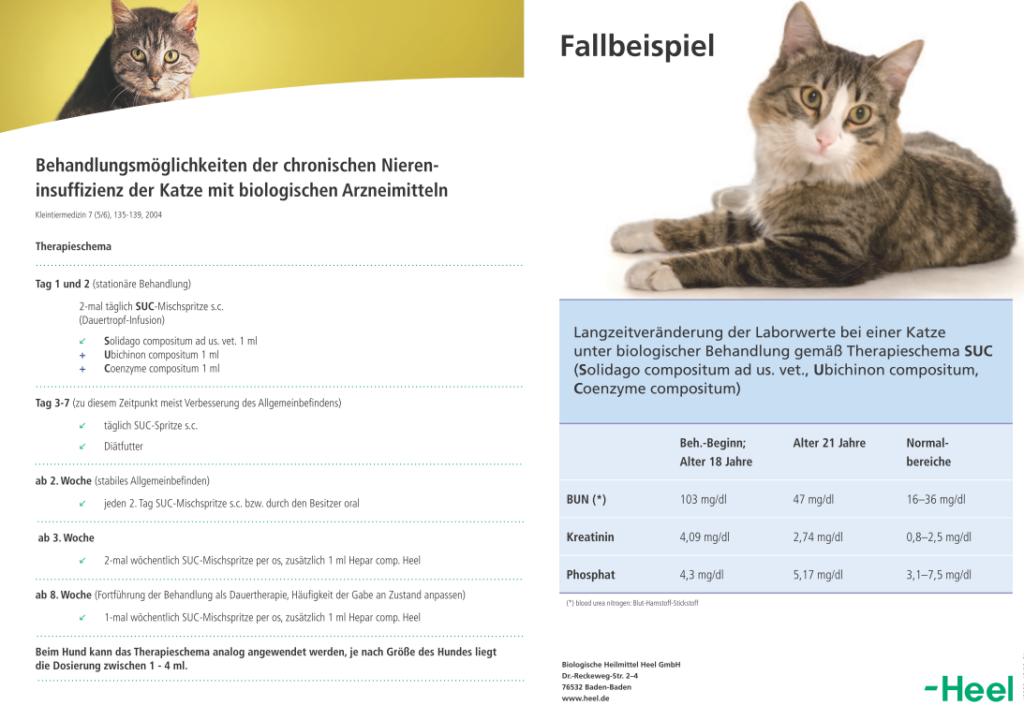
I first discovered it in 2011, when my 17-year-old cat was diagnosed with CKD. At the time, it was almost unheard of outside Germany. I began studying it through the original Heel scientific documentation and with the guidance of a German veterinarian who was actively collaborating with Heel at the time — and who generously shared the handwritten protocol photo you can see in this article.
The strength of this therapy lies in its multi-target approach: the three components act on different but synergistic mechanisms, covering inflammation, oxidative stress, and mitochondrial energy metabolism — all processes that drive CKD progression.
How Do the Three Components of SUC Therapy Work?
Solidago Compositum
Solidago Compositum is the renal cornerstone of the protocol. It contains extracts of Solidago virgaurea (goldenrod) combined with other homotoxicological remedies, with the following documented actions:
- Anti-inflammatory on renal tissue
- Diuretic — comparable to the effect of benazepril according to published research
- ACE inhibition (Angiotensin-Converting Enzyme)
- Anti-fibrotic — may slow the progression of renal fibrosis
⚠️ Important note: I always prefer and recommend Solidago S (the standard formulation) over Solidago ad us. vet., due to its more complete composition.
The role of ACE in CKD is critical: the glomerular hypertension it causes progressively damages the glomeruli and activates pro-inflammatory and pro-fibrotic pathways. Solidago acts precisely on this mechanism.
Ubichinon Compositum
Ubichinon Compositum contains ubiquinone (coenzyme Q10) in homotoxicological form. It is indicated for:
- Stimulating the body’s defence mechanisms against uremic toxins
- Reactivating blocked enzymatic functions in degenerative diseases
- Supporting oxidative phosphorylation
- Antioxidant action against free radicals
The underlying rationale for its use in CKD is that reduced mitochondrial respiratory capacity may be both a cause and a consequence of chronic renal damage. Ubichinon Compositum targets this critical intersection.
Coenzyme Compositum
Coenzyme Compositum is the third pillar of the protocol, working in synergy with Ubichinon to:
- Improve mitochondrial respiration and reduce oxidative stress in renal tissue
- Support the citric acid cycle (Krebs cycle)
- Optimise cellular detoxification processes
The two products are almost always used together because they cover complementary aspects of cellular energy metabolism.
How Is the Heel SUC Protocol Administered?
SUC Therapy is supplied in 2.2 ml ampoules and can be given in two ways:
➡ Subcutaneous injection: The most effective route, especially in advanced stages or during acute decompensation. Must be performed by a veterinarian or trained professional. Provides immediate and complete bioavailability.
➡ Oral administration (home management): The most common approach for day-to-day home care. Draw the contents of the ampoules into a needle-free syringe and gently squirt into the side of the cheek, or mix into a very small amount of palatable food or a soft treat. Less potent than the injectable route, but practical and well-tolerated by most cats.
My personal take: during acute flare-ups or decompensation, subcutaneous is the only route that really delivers. For long-term maintenance, the oral route is entirely manageable — and most cats accept it without drama once you find the right food vehicle.
Heel Protocol Dosage: How Is It Calculated?
There is no universal dosage. Each CKD stage (IRIS 1 through IRIS 4) requires an individualised approach. The Heel guidelines for the standard SUC single dose indicate:
| Component | Amount per dose |
|---|---|
| Solidago Compositum | 1 ml |
| Ubichinon Compositum | 1 ml |
| Coenzyme Compositum | 1 ml |
All three millilitres are drawn into a single syringe and administered together.
The 2020 multicentre cohort study — involving 136 cats with CKD, of whom 33 received SUC therapy and 35 received benazepril — found that SUC Therapy is more effective when administered at least twice a week.
Results showed that serum creatinine remained close to baseline in both groups, with slightly improved values in the SUC group. The clinical composite score improved significantly in the SUC group at days 3, 7, 28, 56, and 112.
⚠️ Frequency and dosage must always be established by a vet experienced in homotoxicology, particularly because SUC Therapy is not appropriate for every form of CKD.
Which Symptoms Does SUC Therapy Address?
These are the uremic symptoms where I have consistently observed the greatest effect of the Heel Protocol — both in my own cat and in the animals I have supported over the years:
✅ Nausea and vomiting — reduction of blood toxin accumulation with improvement of gastric symptoms
✅ Lethargy and apathy — improved energy levels and general activity, often noticeable within the first few days
✅ Loss of appetite — appetite-stimulating effect that helps counter the weight loss typical of advanced CKD
✅ Renal inflammation — documented anti-inflammatory action on renal tissue from all three components
The Real Limits of the Heel Protocol: What It Does NOT Do
I need to be very clear here, because I regularly see the Heel Protocol misrepresented in online groups as a “cure” for CKD.
The Heel SUC Protocol does not slow the progression of kidney disease. It is a valuable symptomatic and metabolic support — but it does not replace a comprehensive CKD management plan.
It is less effective — or not indicated — when CKD is secondary to:
- Viral infections (FIV/FeLV)
- Lymphoma
- Renal cysts or hydronephrosis
- Congenital defects
- Pyelonephritis
- Kidney stones
- Toxin or drug-induced damage
In these cases, the underlying cause must be addressed in parallel. SUC Therapy can play its part, but it cannot carry the whole weight on its own.
Complete CKD management requires an integrated approach: species-appropriate diet, phosphorus control, Omega-3 supplementation, probiotics for enteric dialysis, and — depending on the stage — targeted nutraceuticals such as Cordyceps for feline CKD and amino acid support for uremic appetite loss.
When Not to Use SUC Therapy
⚠️ SUC Therapy is not a one-size-fits-all treatment. A thorough veterinary assessment to rule out the conditions listed above is essential before starting.
Even in animals that appear suitable, individualisation remains non-negotiable: age, IRIS stage, comorbidities, and individual response all influence outcomes.
💬 My Personal Take
I have been using SUC Therapy since 2011 — back when barely anyone in Italy had heard of it. I studied it through the original Heel documentation and thanks to a German vet who was working directly with Heel at the time. He sent me that rare handwritten protocol photo, which I still keep.
Over thirteen years, I have seen SUC Therapy make a real difference in three specific scenarios: acute decompensation episodes, elderly cats with stable chronic CKD, and as a bridging support while building a more comprehensive integrative protocol.
But I also see it used recklessly in Facebook groups — as if it were a universal fix. It is not. Used without a diagnosis, without personalisation, without the other essential pieces of CKD management, it won’t help — and it may cause you to lose valuable time.
If you want personalised support for your animal, visit the link in the description to book a consultation.
FAQ — Frequently Asked Questions About the Heel Protocol for CKD
Can the Heel Protocol replace benazepril in cats with CKD? According to the 2020 cohort study, SUC Therapy is not inferior to benazepril in cats with mild-to-moderate CKD. However, the choice between them — or their combination — is a decision for your vet, based on IRIS stage and the animal’s specific condition.
How often should SUC Therapy be given? The 2020 study indicates that administration at least twice a week produces the best results. In practice, frequency is individualised by the vet according to disease severity and patient response.
Is Solidago Compositum S better than Solidago ad us. vet.? I prefer Solidago S for its more complete formulation. I have written a dedicated article comparing both versions — check it out on elicats.com before buying.
Can the Heel Protocol be used in dogs with CKD as well? Yes, SUC Therapy is indicated for both cats and dogs with chronic kidney disease. Dosage and frequency must be adapted to the animal’s size and disease stage, always under veterinary guidance.
Can I administer SUC Therapy at home without a vet? The oral route is manageable at home. However, the full protocol — dosage, frequency, composition — must be set by a vet experienced in homotoxicology. Never start independently, especially in advanced CKD stages.
Is the Heel Protocol effective for all types of CKD? No. It is less effective — or contraindicated — when CKD is secondary to FIV/FeLV, lymphoma, kidney stones, hydronephrosis, pyelonephritis, or congenital defects. In these cases, the primary cause must be treated concurrently.
Disclaimer: This content is for informational purposes only and does not constitute medical advice or replace veterinary consultation. The homeopathic and natural remedies mentioned have no scientifically validated efficacy. Always consult your vet before making changes to your pet’s diet or administering any remedy.
Update June 2020 Heel Protocol Multicomponent therapy, cohort study.
Multicomponent, multitarget SUC therapy in cats with chronic kidney disease: a multicenter, prospective, observational, non-randomized, selected one hundred and thirty-six cats with CKD. Thirty-three cats were assigned to SUC treatment and 35 cats received benazepril.
Results: Serum creatinine remained close to baseline in both study groups with slightly improved values in the SUC group. The clinical summary score improved significantly in the SUC group on days 3, 7, 28, 56, and 112, but not on day 168.
The results of this study indicate that the results indicate that SUC therapy may be more effective if administered at least twice a week.
The objective of this study was to evaluate the tolerability and efficacy of SUC therapy (Solidago compositum ad us. Vet., Ubichinon compositum and Coenzyme compositum).
The SOLIDAGO COMPOSITUM
It has antimicrobial, analgesic, anti-inflammatory, spasmolytic and diuretic activity, the diuretic activity is comparable to the effect of benazepril.
The diuretic activity of S. virgaurea has been linked to ACE inhibition comparable to the effect of benazepril.
ACE (Angiotensin-Converting Enzyme)
As we know, ACE plays a fundamental role in the development of chronic renal failure, the angiotensin-converting enzyme causes glomerular hypertension with consequent glomerular damage and activation of proinflammatory and profibrotic pathways. Solidago can reduce inflammation of kidney tissue and at the same time prevents fibrosis.
The results of the current study showed that the multicomponent and multitarget SUC combination is non-inferior to the ACEI benazepril commonly used for the treatment of cats with chronic renal failure of mild to moderate severity, with similar effects on laboratory parameters indicative of disease progression.
Ubiquinone Compositum and Coenzyme are indicated for the stimulation of defense mechanisms against toxins and to reactivate blocked and defective enzymatic functions in degenerative diseases. Improves oxidative phosphorylation and antioxidant action against free radicals; in fact, Ubiquinone Compositum improves the citric acid cycle and therefore has cellular support and detoxification characteristics.
Reconsidering the Approach to the Treatment of Renal Failure in Dogs and Cats (2024)
I frequently receive requests for counseling for dogs and cats with chronic kidney failure (CKD), often accompanied by specific questions about the Heel protocol.
I would like to clarify that, although the Heel protocol can be supportive, it is neither the only nor the universal treatment to slow the progression of kidney failure or reduce creatinine and BUN levels.
It is important not to consider the Heel Protocol as the only solution for CKD.
Although it may be useful, its administration is not sufficient to manage all the symptoms related to CKD, nor to significantly reduce creatinine and BUN levels.
Nausea and Vomiting
- SUC therapy can help reduce nausea and vomiting, which are common symptoms in cats with kidney failure due to the accumulation of toxins in the blood.
2. Apathy and Lethargy
- Cats with kidney failure often show signs of apathy and lethargy. SUC therapy can improve your cat’s energy level and overall activity.
3. Loss of Appetite
- The therapy can stimulate appetite in cats, helping to counteract the weight loss and malnutrition that often accompanies kidney failure.
4. Kidney inflammation
- The components of SUC therapy may have anti-inflammatory effects, helping to reduce inflammation of kidney tissue.
The Heel Protocol does not slow the progression of kidney disease
1. Efficacy Yes, but other preparations and supplements must be added
- SUC therapy has been shown to be effective in treating chronic kidney failure, but it is not sufficient on its own to manage all symptoms or significantly reduce creatinine and BUN levels. It is most effective when used in combination with other therapies and treatments.
2. Personalization of Therapy
- The administration of SUC therapy should be individualized according to the degree of disease and the specific condition of the patient. For example, it may be more beneficial in older animals with chronic renal failure, but less effective in the presence of other concomitant diseases such as viral infections (FIV/FELV), lymphomas or kidney stones.
Kidney disease can have different origins, such as viral infections, immune problems, congenital conditions, side effects of medications, and other factors.
The Heel protocol is particularly beneficial in older animals with chronic CKD, but less effective in the presence of other pathologies that can trigger CKD, such as FIV/FELV, lymphomas, cysts, hydronephrosis, birth defects, pyelonephritis, kidney stones, or damage caused by toxins and drugs.
I share this information because it is crucial to understand that the management of kidney failure requires a personalized and well-informed approach. Once these concepts are understood, one can not only delay the progression of the disease, but also manage it more effectively and appropriately.
I am an independent researcher, passionate about nutrition, wellness and natural therapies for over 20 years, with a specialization as an Animal Naturopath. For the past 13 years, I have been studying unconventional therapies in veterinary medicine after my 17-year-old cat was diagnosed with chronic kidney failure in 2011.
In that year, I began to experiment with innovative treatments, such as mycotherapy with Cordyceps, unknown in Italy, together with the Heel Protocol, MAP/Gunamino and Omegor. These natural remedies, which I personally tested on my cat in 2011, have proven to be surprisingly effective in improving their quality of life.
Over the years, I have continued to test a wide range of phytotherapeutic, mycotherapeutic and homotoxicological remedies, which have restored vitality to my cat and helped many other animals.
In parallel, I have shared my experience and scientific knowledge on various forums, Facebook groups and through my website, Elicats.it.
I invite you to explore my website, where you will find valuable information to support your animals. However, it is essential to rely on professionals for the management of kidney disease and other conditions, as remedies must be introduced carefully, taking into account the animal’s state of health.
Important note: in many Facebook groups, remedies taken from my site are often recommended without the necessary expertise and without a personalized evaluation. Following these tips blindly can be potentially harmful to your pet. The remedies I have shared are the result of years of research, experimentation and dedication, and must be used with the utmost caution. Always remember to consult a qualified professional before embarking on any treatment.
Cat renal failure (CKD) is a disease that can be acute or chronic. Only early diagnosis, followed by targeted and natural treatments, allows an improvement in the quality of life.
Disclaimer: The Contents Are For Informational Purposes Only And Under No Circumstances Can They Constitute A Prescription Of A Treatment Or Substitute For A Specialist Visit Or Direct Relationship With Your Veterinarian/Doctor. All information reported here is derived from bibliographic sources, personal experiences and clinical studies in the public domain. The information disseminated on the site is published after careful verification of the sources, carefully chosen and as far as possible updated and official. All Information On Special Diets And Food Supplements For Pets Is For Informational Purposes. This information serves as a general guideline, it cannot be applied to all pets or considered as alternatives to professional advice. In these pages are inserted and presented alternative therapy and homeopathic remedies of unscientifically validated efficacy and without approved therapeutic indications. The products are not intended as a substitute for a varied and balanced diet and must be used as part of a healthy lifestyle. Disclaimer and Terms


Discussion about this post