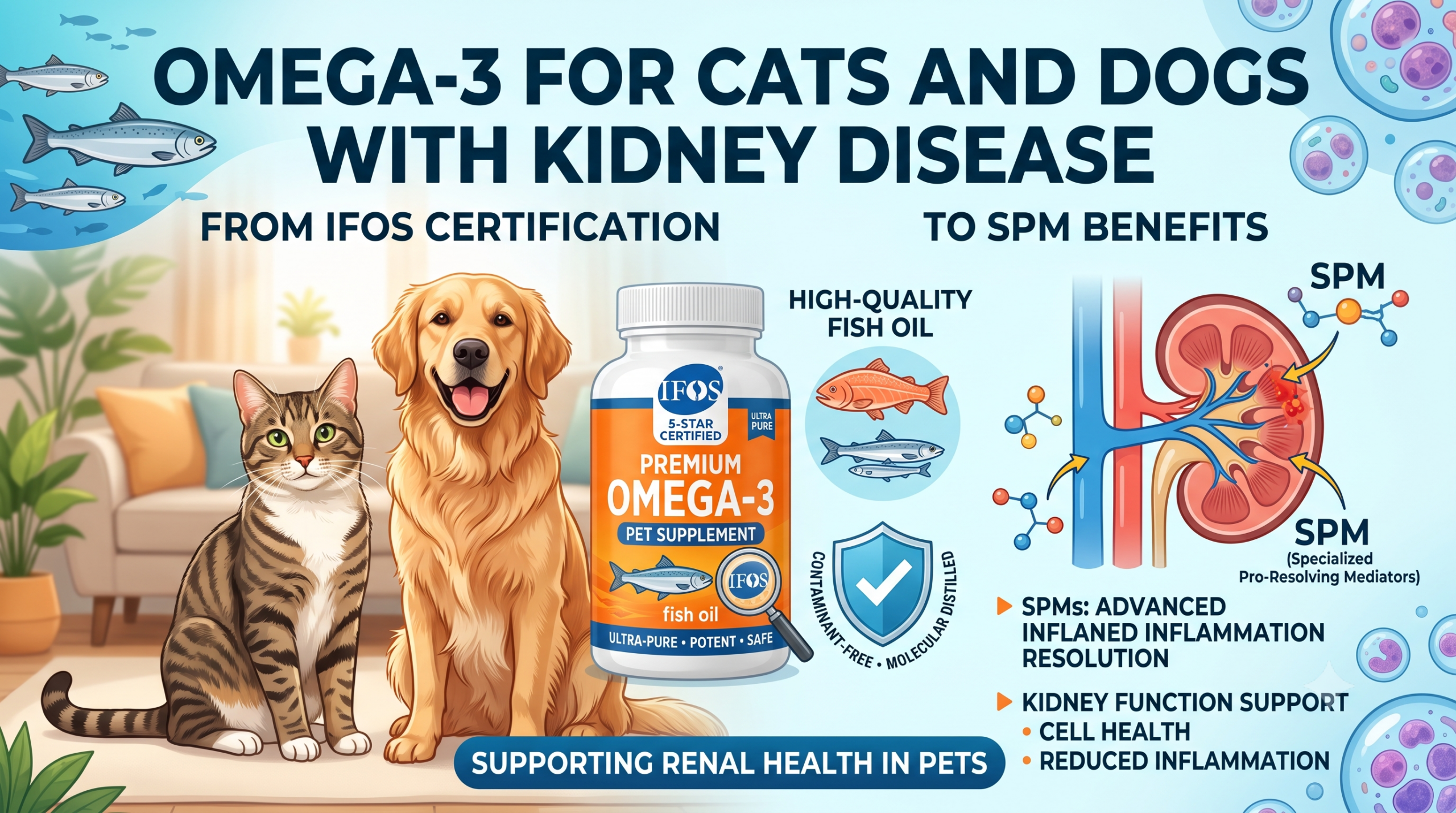
Omega 3 fatty acids are among the most strongly supported supplements in the veterinary literature for chronic kidney disease in cats and dogs. EPA and DHA improve glomerular filtration rate, reduce intraglomerular pressure and lower proteinuria in animals with chronic glomerular disease. But two conditions have to be met before any of that happens: the oil must be genuinely pure and unoxidised, and the animal must still be able to convert it.
I have used pharmaceutical-grade, IFOS-certified omega 3 since 2011, starting with my own cat. This is how I got there — and why, after fifteen years, I changed approach again.
Why I could not give up on omega 3 in a kidney patient
I did not arrive at this from veterinary practice. I arrived at it from human nutrition.
2001. I came to omega 3 through Barry Sears and the zone diet. In that framework omega 3 is not a casual supplement: it counteracts inflammatory eicosanoids and regulates the deeper hormonal system. Once you understand that mechanism, you cannot un-see it in animals.
At the time, where I lived, there was no pure omega 3 available for daily use. The only options were two prescription drugs. No certification. No guarantee on heavy metals. No guarantee on oxidation.
2004–2005. The first IFOS five-star certified oils reached the market. For human use only. Nobody was using them in veterinary medicine.
2011. My own cat was diagnosed with chronic kidney disease.
By then I already knew what omega 3 does to the kidney: it improves residual renal function, lowers arterial pressure, reduces inflammation, and reduces proteinuria in chronic glomerular disease. Brown’s 1998 work in a canine model was already unambiguous on all four points.
So giving up on it was not an option I was willing to consider.
The problem nobody was talking about: rancid oil
I bought the omega 3 products formulated for pets — what the market offered at the time. The results were disappointing in a way I still remember physically.
The smell of rancid oil. Hypersalivation. Jaw clamped shut. Complete food refusal the moment I tried to hide it in the wet food.
My cat’s nose was more honest about that product than its label was.
And here is what took me longer to accept than it should have: a rancid omega 3 is worse than no omega 3 at all. An oxidised oil does not merely fail to reduce inflammation — it adds to the oxidative stress you are trying to control in a kidney patient. In poor-quality products, it can go further than that: an oxidised or heavy-metal-contaminated fish oil can trigger pancreatitis in cats. I have had reports from owners who ran into exactly this.
I was not dealing with a fussy cat. I was dealing with a bad product.
One capsule, one needle
So in 2011 I did something nobody around me was doing.
I took a human capsule, IFOS five stars. I pierced it with a needle. I drew out about half of the oil with a syringe. And I gave it to my cat with CKD.
No rancid smell. No hypersalivation. No refusal.
I want to be honest about what that was and what it was not. It was not a validated protocol. It was an empirical clinical decision, built on human literature and applied to a cat, by someone who had run out of acceptable alternatives. I was alone in doing it, and I knew I was alone. No vet around me was doing it. No guideline mentioned it.
What made me comfortable was not confidence. It was that the reasoning could be stated out loud and defended, step by step: the molecule is the same, the mechanism is documented, the quality is verified by a third party, and the dose can be scaled down.
Fifteen years later, pharmaceutical-grade omega 3 is ordinary clinical practice. Owners bring it to their vet. Vets prescribe it. Manufacturers eventually developed veterinary lines with genuinely acceptable quality, which was simply not true in 2011.
I do not claim credit for that shift. But the episode illustrates something I keep meeting in integrative practice: the gap between what the evidence already supports and what is routinely done is often years wide, and it usually closes when somebody reasons from mechanism before the product category catches up.
What IFOS certification actually means
IFOS — the International Fish Oil Standards programme — is a third-party testing scheme that verifies individual fish oil batches for heavy metals, oxidation, and actual EPA and DHA content against the label. A five-star rating means that batch met the highest thresholds.
Two details most people miss:
✅ It is a batch-level certification. A brand can hold it for one production run and not another, so the certification matters more than the name on the bottle.
✅ Concentration is not a detail. Generic fish oils typically declare 20 to 30 percent EPA plus DHA. Certified pharmaceutical-grade oils reach 70 to 85 percent — which changes how many capsules you need, and how much oxidisable material you are asking a compromised kidney to deal with.
In long-term supplementation of a kidney patient, this is where I refuse to compromise.
And then, after fifteen years, something stopped adding up
For years the reasoning held. And then it stopped.
I was seeing animals on high-quality IFOS omega 3 for months, some for years, with good bloodwork, who were still chronically inflamed. The atopic dog scratching less but never stopping. The CKD cat with stable creatinine but advancing renal fibrosis. The arthritic senior improving, then declining again, one season after another.
I asked myself the same question that, in 2011, had led me to that capsule and that needle. And the answer turned out to be something I had never considered: in a chronically inflamed animal, the enzymatic conversion of omega 3 into the molecules that actually resolve inflammation is impaired. We keep supplying the fuel, but the conversion engine has seized.
That is where SPM — specialized pro-resolving mediators, the family described by Professor Charles Serhan at Harvard in 2014 — come in.
I explain the whole thing in the video below: why the conversion breaks, what SPM actually do that omega 3 cannot, the paradox of chronic anti-inflammatory therapy that almost nobody discusses, and how I now approach chronically inflamed patients. It is the full reasoning, not a summary.
📺 After Fifteen Years I Stopped Giving My Cats Omega 3 — Here’s Why
🌿 Subscribe if you want to follow real integrative veterinary medicine.
FAQ
Does this mean omega 3 is useless now? No, and this is the most common misreading. In a healthy animal, IFOS-certified omega 3 remains fundamental and I still use it. What changed is my approach to the chronically inflamed patient, where supplying precursors alone has repeatedly proved insufficient. Two tools, two situations — not a replacement.
Can I give human omega 3 capsules to my cat? Yes, provided the product is IFOS certified and free of additives that are problematic for cats — no excess vitamin D, no xylitol. The amount must be calibrated by your vet, particularly in a cat with kidney disease or on concurrent medication. Certified veterinary products now exist and are the simpler route.
How do I know if a fish oil has gone rancid? Smell it. A fresh oil smells faintly of the sea; an oxidised one smells sharply fishy or of paint. Animals detect it before we do, so sudden refusal of a previously accepted supplement is a genuine warning sign. Check expiry dates and store away from heat and light.
How long before I see results from omega 3 on the kidney? Anti-inflammatory effects appear after four to eight weeks of consistent administration. Changes in bloodwork — creatinine, BUN, UPC — take at least two to three months. Consistency matters more than dose escalation.
What dose should I give? This is genuinely a veterinary decision. In CKD the dosing is close to pharmacological and depends on IRIS stage, blood pressure, degree of proteinuria and concurrent medication. Note also that omega 3 needs caution alongside anticoagulant medication and is usually suspended five to seven days before surgery.
📌 My personal note
The product I have used for my own cats for over a decade is Omegor Vitality 1000, an IFOS five-star certified pharmaceutical-grade human fish oil produced by UGA Nutraceuticals, using molecular distillation that removes heavy metals and guarantees the declared concentration. I mention it purely from personal experience.
Distribution outside continental Europe is limited, so if you cannot source it, the criterion matters more than the brand: IFOS five-star certification on the specific batch, verifiable third-party analysis, and a declared EPA plus DHA concentration you can actually check.
Always discuss it with your vet before starting. If your vet is unfamiliar with IFOS, print this page and bring it to the appointment.
Disclaimer
Disclaimer: This content is for informational purposes only and does not constitute medical advice or replace veterinary consultation. All information derives from published literature, personal experience and clinical studies in the public domain. Nutritional supplementation is a supportive measure and does not replace prescribed therapy. Always consult your vet before making changes to your pet’s diet or administering any supplement, particularly in an animal with chronic kidney disease or on concurrent medication.



Discussion about this post