


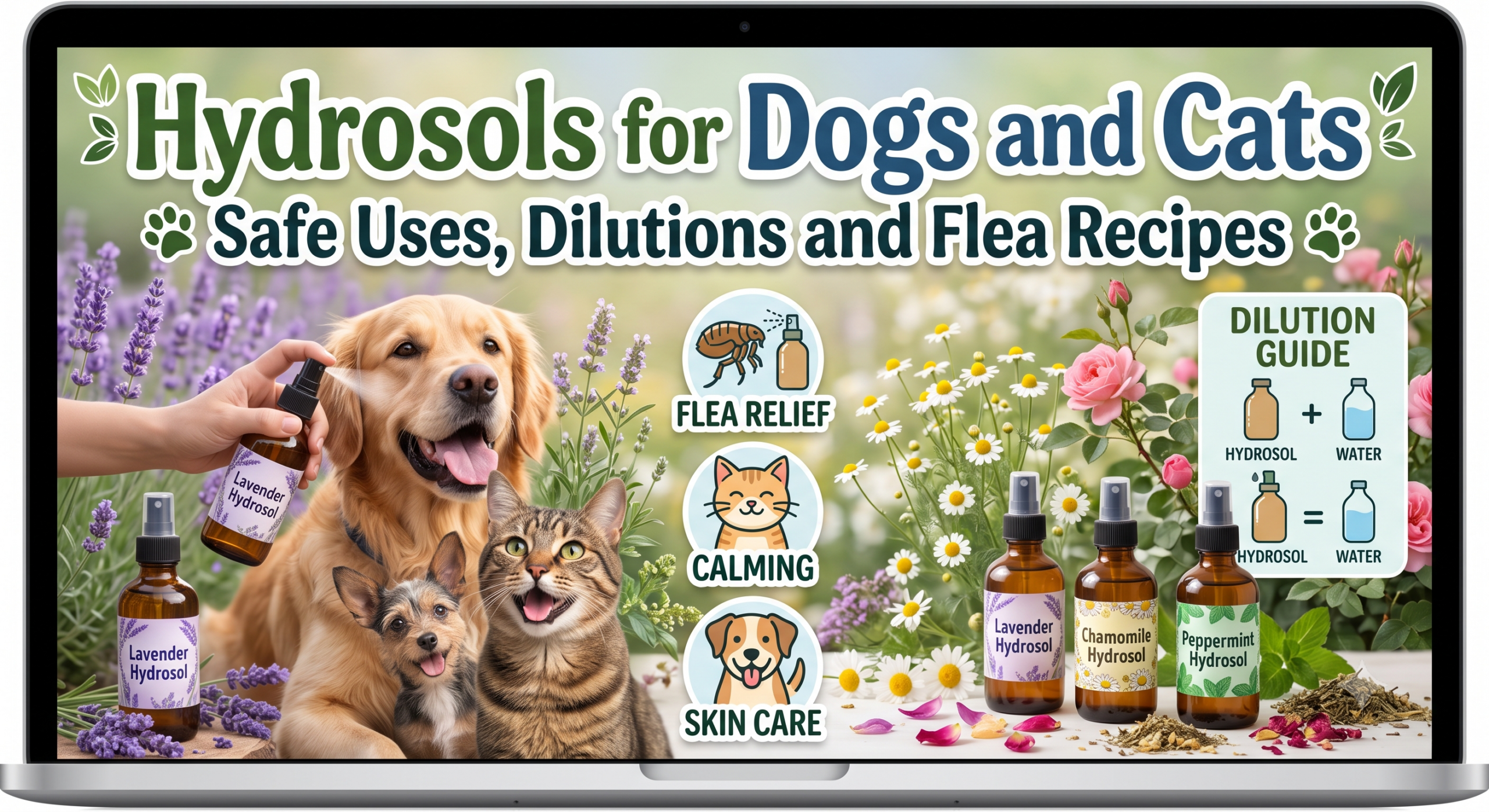
Hydrosols — also called floral waters or hydrolats — are the aromatic waters left behind after steam-distilling a plant. They carry less than 0.05% water-soluble aromatic molecules, a tiny fraction of what you’d find in an essential oil. That’s exactly why they’re the one form of aromatherapy I consider genuinely safe around cats. The most useful ones for pets are lavender, Roman chamomile, lemon balm, witch hazel and rose. Apply them to skin and coat — neat on dogs, diluted on cats — and never internally without professional guidance.
I’m Eli, an animal naturopath with more than fourteen years of clinical practice. Hydrosols are one of the few aromatic tools I keep on hand even with senior and medically fragile cats — and one of the few I’ll recommend to a first-time owner without a long list of caveats.
What exactly is a hydrosol?
A hydrosol is the distillation water that separates from the essential oil at the end of steam distillation. It isn’t a waste product. It’s a saturated aqueous solution holding the water-soluble aromatic molecules — the gentler, less reactive end of the plant’s chemistry.
Three practical differences from essential oils:
✅ Extremely low concentration — roughly 0.02–0.05% active compounds versus 100% in an essential oil ✅ Direct skin application — no carrier oil needed ✅ Mildly acidic pH (typically 4.5–6.5), compatible with the acid mantle of dog and cat skin
So floral waters work on irritation, itch and emotional tension much like their oily cousins — just far, far lighter.
⚠️ Don’t confuse a true hydrosol with “floral water” fragrance products. Plenty of what’s sold in that category is demineralised water plus fragrance and preservative. That’s not a distillate, and it has no place on your animal’s skin.
Are hydrosols safe for cats?
Cats are physiologically deficient in glucuronyl transferase, the liver enzyme that conjugates phenols and terpenes for excretion. That’s the reason essential oils can accumulate and become toxic at doses a dog handles without trouble — a well-documented risk that veterinary poison centres such as Pet Poison Helpline and ASPCA Animal Poison Control flag repeatedly.
Hydrosols largely sidestep the problem because the aromatic load is hundreds of times lower. But “safer” is not “unregulated”:
➡ Dilute at least 1:1 with water for the first applications on any cat ➡ Never spray near the face or eyes — mist your hands and stroke the coat instead ➡ Watch for 24 hours after the first use (drooling, head shaking, fleeing the smell = stop) ➡ If your cat walks away decisively, that’s your answer. The cat chooses; I only offer.
Olfactory self-selection is clinical information, not fussiness. I’ve learned to trust it.
Which hydrosols are safe for dogs and cats: quick reference
| Hydrosol | Dog | Cat | Main use |
|---|---|---|---|
| True lavender (Lavandula angustifolia) | ✅ neat | ✅ 1:1 diluted | Irritation, itch, wound healing, calming |
| Roman chamomile (Chamaemelum nobile) | ✅ neat | ✅ 1:1 diluted | Redness, anxiety, around (not in) the eyes |
| Lemon balm (Melissa officinalis) | ✅ neat | ✅ 1:1 diluted | Nervousness, eczema, healing |
| Witch hazel (Hamamelis virginiana), alcohol-free | ✅ neat | ✅ 1:1 diluted | Astringent, hot spots, weeping lesions |
| Rose (Rosa damascena) | ✅ neat | ✅ 1:1 diluted | Sensitive skin, eye area, kittens |
| Calendula | ✅ neat | ✅ 1:1 diluted | Skin repair, minor wounds |
| Helichrysum (Helichrysum italicum) | ✅ neat | ⚠️ 1:3 only | Bruising, contusions, post-trauma |
| Atlas cedarwood | ✅ 1:1 | ⚠️ not advised | Repellent, coat tonic |
| Rosemary | ✅ 1:1 | ❌ avoid | Flea repellent |
| Thyme | ✅ 1:3 | ❌ avoid | Skin antimicrobial |
| Bay laurel (Laurus nobilis) | ✅ 1:3 | ❌ avoid | Antimicrobial, possible sensitiser |
| Tea tree (Melaleuca alternifolia) | ✅ 1:3 | ❌ never | Strong antimicrobial |
| Peppermint, citrus, clove | ⚠️ occasional | ❌ avoid | — |
⚠️ Skip rosemary and helichrysum in dogs with a seizure history. During pregnancy and lactation I stick to lavender, chamomile and rose only.
The six hydrosols I reach for most
Lavender hydrosol for dogs and cats
My all-rounder, and the one bottle I’d tell a beginner to buy. Look for true lavender, not lavandin.
- Soothes skin irritation and itching
- Supports wound healing
- Excellent for feline chin acne and canine acne, dabbed on with a cotton pad
- Helpful for itch in atopic dermatitis
- Coat cleansing and mild repellent effect against mosquitoes and fleas
- Calming for tense, reactive animals
Practical dosing: dogs over 45 lb (20 kg) → 4-6 spritzes over the coat, neat. Dogs 22-45 lb (10-20 kg) → 3-4 spritzes. Dogs under 22 lb and puppies → 1:1 diluted, 2-3 spritzes. Cats → 1:1, misted onto your hand and stroked through the coat. Once daily during flare-ups, then 2-3 times weekly.
Roman chamomile hydrosol
It calms redness and irritation, but its real strength is emotional. Stroked through the coat, it settles anxious and agitated animals.
I use it on a cloth or on bedding about thirty minutes before a stressful event — carrier, car journey, vet visit, thunderstorms. On fabric rather than on the animal if your pet is scent-reactive.
It’s also the only one I consider gentle enough for a compress around the eye — on the closed lid with sterile gauze, never in the eye.
Lemon balm (melissa) hydrosol
Calming, healing, useful against eczema and irritation. If your dog or cat is nervous, hyper-reactive, or licking compulsively, melissa is my first choice — often alternated with chamomile so the scent doesn’t lose its effect.
Witch hazel hydrosol
Astringent, antibacterial, antiseptic. This is my go-to for weeping lesions: hot spots, skin folds, areas an animal has licked raw.
Dab it on with a cotton pad twice daily. It must be strictly alcohol-free — the drugstore witch hazel astringent most people have in the bathroom contains alcohol, stings on open skin and is irritating to cats.
It also takes the edge off itching in dermatitis.
Rose hydrosol
The gentlest of the lot. I use it on kittens, puppies, seniors and very sensitive skin — and as the base for diluting other hydrosols instead of plain water.
Atlas cedarwood hydrosol
Improves coat and skin condition and helps repel fleas. Dogs only, diluted 1:1. I skip it in cats — cedarwood is ketone-rich and I’d rather not gamble on a liver that already works differently from ours.
Tea tree hydrosol — dogs only
A strong antimicrobial, useful on localised bacterial dermatitis in dogs, always diluted 1:3.
⛔ Never on cats, in any form, at any dilution. Tea tree is one of the most common causes of aromatic poisoning in cats. This isn’t precautionary hedging — it’s an absolute contraindication.
Five ways to use hydrosols on pets
- Coat spray — dark 100 ml (3.4 oz) bottle, 3-6 spritzes by size, avoiding head and face
- Cotton pad application — the method of choice for cats and for localised lesions
- Compress — 1 tbsp hydrosol in ½ cup (100 ml) warm water, soaked gauze, five minutes
- Environment — misted on bedding, blankets, carriers; never directly at the animal
- Post-bath rinse — 2 tbsp in 2 cups (500 ml) warm water, poured on and left in
❌ Internal use: no. You’ll see advice about adding hydrosol to the water bowl. I don’t recommend it. Cats can reduce their water intake because of the taste, and in an animal with chronic kidney disease hydration is the single highest priority. Internal use should only ever be assessed case by case with a professional.
Natural flea spray with hydrosols — for dogs
Take a 100 ml (3.4 oz) dark plastic spray bottle and combine:
- 10 ml lavender hydrosol
- 10 ml rosemary hydrosol
- 10 ml cedarwood hydrosol
- 10 ml thyme hydrosol
- 10 ml cold-pressed organic neem oil
- top up with distilled water
Shake well before every use — the oil separates. Spray or work through the coat daily for one week, then once weekly for maintenance. Store in the fridge.
⚠️ Do not use this formula on cats: the rosemary, thyme and cedarwood content is not appropriate for them.
Natural flea blend with hydrosols — for cats
Neat or low-grade neem can irritate cats, causing eye and skin reactions. The quantity has to drop sharply.
In a 5 ml syringe combine:
- 5 drops cold-pressed organic neem oil
- 1 ml lavender hydrosol
- 1 ml rosemary hydrosol
Apply a few drops along the spine with the syringe, daily for one week, then 1-2 times weekly. Store in the fridge and shake well before use.
➡ In my experience these blends work as repellents, not as parasiticides. They make your animal less attractive to fleas and are useful preventively or alongside other measures, but an established infestation needs different tools — I cover those in the natural flea and tick article. They are not a substitute for veterinary parasite prevention in areas where tick-borne disease or heartworm are endemic.
How to choose and store hydrosols
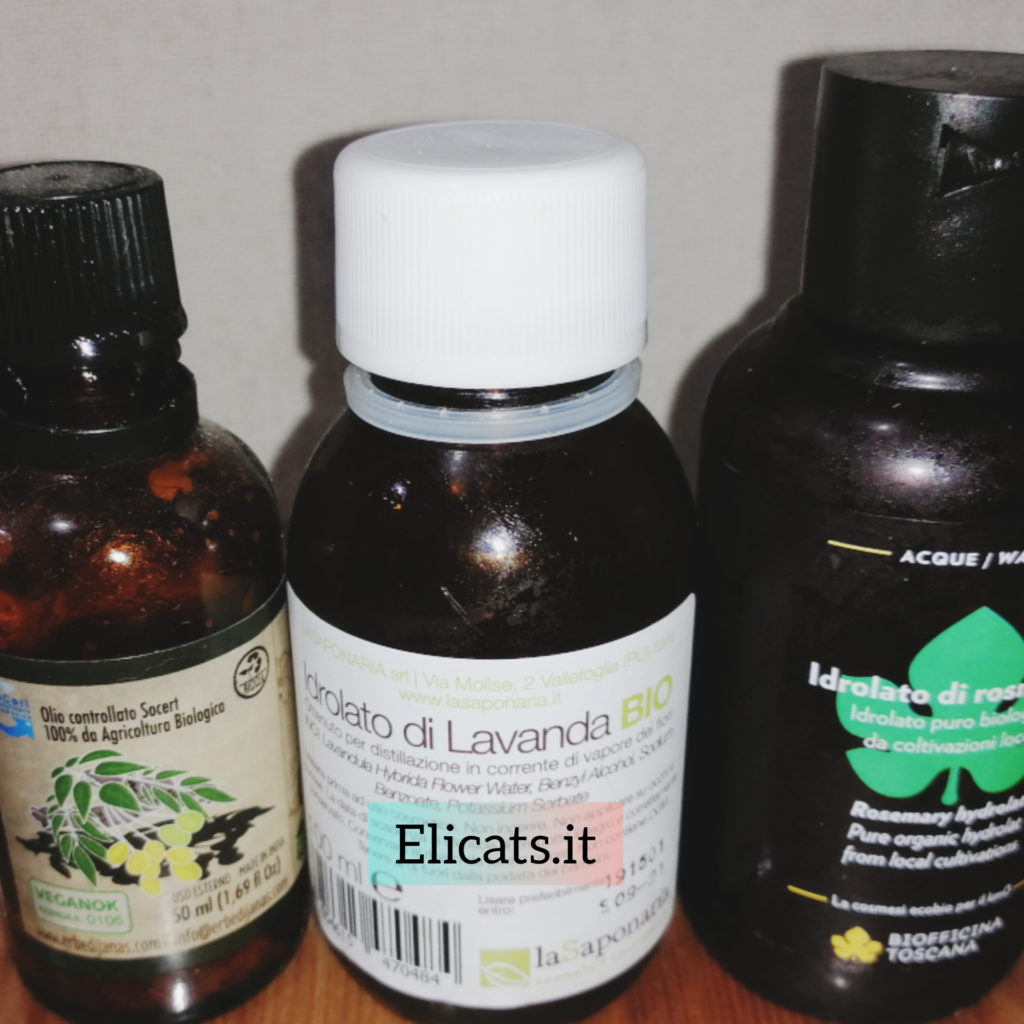
Buy only from certified distillers. Check the label: it should list one single ingredient.
What a correct label looks like: Ingredients (INCI): Lavandula angustifolia (Lavender) flower water
Nothing else. No alcohol, no phenoxyethanol, no “parfum”. 😉
Reliable sources in the English-speaking market: Aromatics International, Eden Botanicals, Florihana, Plant Therapy hydrosols, and any small distiller who publishes distillation dates and batch numbers. For witch hazel, look specifically for an alcohol-free distillate.
Storage:
- Cool, dark, stable temperature year-round
- Refrigerate in warm weather — always
- Shelf life: 6-12 months after opening
- ⚠️ Cloudiness, floating filaments or a sour smell mean the hydrosol has “bloomed” with bacteria. Throw it out.
When to call your vet
Hydrosols are surface support, not treatment. Book an appointment if you see:
- A lesion spreading or discharging pus within 48-72 hours
- Itching intense enough to prevent sleep
- Patchy hair loss, widespread crusting, or a strong skin odour
- Ear infection with head shaking and pain
- In cats: drooling, wobbliness, tremors or vomiting after an application → emergency, go now
- Any skin lesion in an immunosuppressed, FIV/FeLV-positive, or steroid-treated animal
Atopic dermatitis, pyoderma and parasitic infestation all need a diagnosis. Hydrosols travel alongside that process — they don’t replace it.
💚 My personal take
If you’re buying one bottle, make it true lavender. That single hydrosol covers itch, minor irritation, coat cleansing and emotional tension. The second I’d add is alcohol-free witch hazel, because nothing else I use works as well on weeping lesions.
And always run the scent test before you apply anything: open the bottle and let your animal sniff it. If your cat turns her head away, you already have your answer. In fourteen years of following cases, that one small habit has saved me from a lot of mistakes.
FAQ — Hydrosols for dogs and cats
Are hydrosols safe for cats? Yes. Most hydrosols are safe for cats when diluted at least 1:1 with water and used only on skin and coat. Exclude tea tree, thyme, bay laurel, rosemary, peppermint and citrus. Cats metabolise phenols and terpenes poorly because they lack glucuronyl transferase.
What’s the difference between a hydrosol and an essential oil? A hydrosol is the distillation water and holds under 0.05% aromatic molecules; an essential oil is 100% of them. Hydrosols go straight onto skin without a carrier oil, while essential oils always need dilution and are frequently contraindicated in cats.
Can I use hydrosol neat on my dog’s skin? Yes. On an adult dog, hydrosols are used neat — except tea tree, thyme and bay laurel, which should be diluted 1:3. For puppies under six months, dilute everything 1:1.
Which hydrosol is best for an itchy dog? True lavender for generalised itch, alcohol-free witch hazel for moist lick lesions, Roman chamomile for redness. You can alternate them, applying twice daily during flare-ups.
Do hydrosols actually repel fleas? They act as repellents, not parasiticides. They reduce how attractive your animal is to fleas and help preventively, but they won’t clear an established infestation on their own.
Can I add hydrosol to my pet’s drinking water? I don’t recommend it without professional guidance. In cats especially, the flavour can reduce water intake — a serious problem in any animal with kidney disease.
How long do hydrosols last? Six to twelve months after opening, stored dark and refrigerated in warm weather. Discard if they turn cloudy or develop floating strands.
Can I use tea tree hydrosol on my cat? No — never, at any dilution. Tea tree is among the most common causes of aromatic poisoning in cats and is absolutely contraindicated.
Disclaimer: This content is for informational purposes only and does not constitute medical advice or replace veterinary consultation. The homeopathic and natural remedies mentioned have no scientifically validated efficacy. Always consult your vet before making changes to your pet’s diet or administering any remedy.


Discussion about this post