


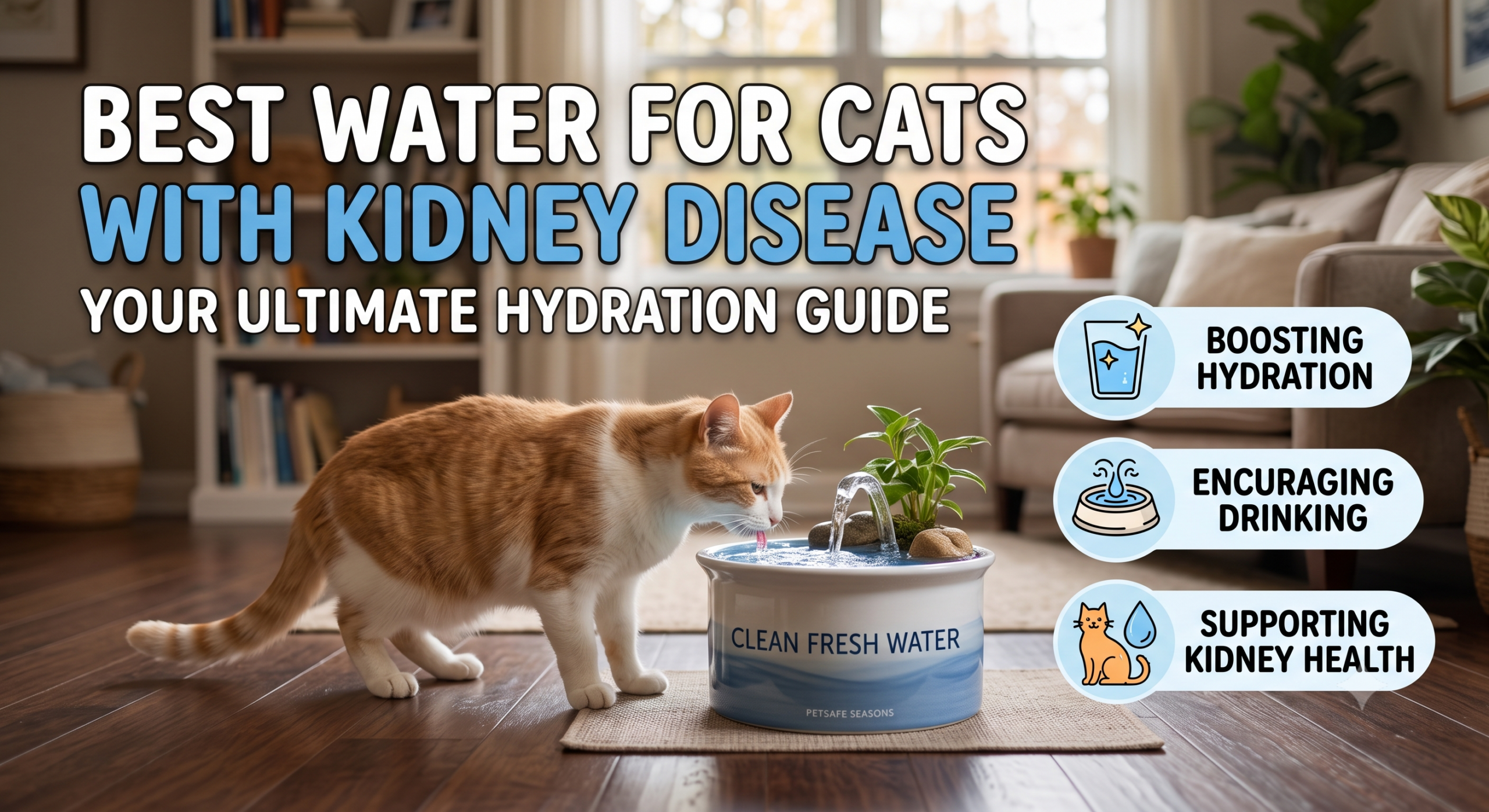
The best water for a cat with kidney disease is any clean, safe, palatable water your cat willingly drinks. No bottled water brand has ever been proven to slow chronic kidney disease in cats. If you choose bottled water, look for a low mineral content, ideally under 50 mg/L of total dissolved solids, and low sodium. But the single biggest hydration lever is not the water bowl at all: it is moisture in food. Wet food is around 75–80% water, dry kibble around 10%. Changing that ratio does more for hydration than changing brands ever will.
I am Eli, animal naturopath, and I have worked with feline chronic kidney disease for over 14 years, including with my own cats. This guide is the one I wish someone had handed me on day one.
Does the type of water matter for a cat with kidney disease?
Yes, but far less than most owners believe.
Water does not repair nephrons. It does not reverse chronic kidney disease. No commercially available drinking water has been shown to slow progression. What water does is support the nephrons your cat still has.
So the useful question is not “which brand should I buy?” It is “how do I help my cat stay consistently hydrated, every single day?”
What does kidney disease do to your cat’s water balance?
The kidney is a filter built from millions of tiny units called nephrons. One of their most remarkable jobs is concentrating urine: filtering an enormous volume of fluid daily, then returning almost all of that water to the body and releasing only waste. Healthy kidneys are extraordinarily efficient water recyclers, which is why a healthy cat survives on surprisingly little drinking water.
In chronic kidney disease, nephrons are lost and do not regenerate. The kidney progressively loses the ability to reclaim water. Picture carrying water in a bucket with a hole in the bottom: no matter how much you pour in, some keeps leaking out.
Urine specific gravity: the number that proves it
There is one value on your cat’s lab report that shows this precisely, and most owners are never shown it.
| Urine specific gravity | What it means |
|---|---|
| Above 1.035 | Healthy concentrating ability in cats |
| 1.013 – 1.035 | Reduced concentrating ability |
| 1.008 – 1.012 | Isosthenuria — urine at roughly the same concentration as blood |
Isosthenuria means the kidney has essentially stopped concentrating. That is the hole in the bucket, measured. When those losses are not replaced, renal blood flow drops, the surviving nephrons have less fluid to filter, and uremic toxins accumulate faster in the bloodstream.
This is why excessive thirst is not reassuring. A cat emptying the water bowl is not thriving. It is compensating.
How much water does a cat with kidney disease need?
A cat needs roughly 50 ml of water per kilogram of body weight per day, from food and drinking combined. For a 4 kg cat, that is about 200 ml.
Here is where the food bowl decides almost everything:
| Diet | Water from food (4 kg cat) | Water the cat must drink |
|---|---|---|
| 3 × 90 g wet pouches (80% moisture) | ~210 ml | Almost none |
| 1 wet pouch + 40 g kibble | ~76 ml | ~124 ml |
| 60 g kibble only (10% moisture) | ~6 ml | ~194 ml |
Same cat. Same kidneys. Completely different starting position.
A mouse, the food a cat evolved to eat, is roughly 70% water. Dry kibble is around 10%. That is the difference between food that hydrates and food that dehydrates, and it is the reason therapeutic renal diets are so often recommended in their wet formulation whenever the cat accepts them.
⚠️ Diet changes in a kidney patient are never neutral. Discuss any transition with your vet, especially in IRIS stage 3 and 4.
Which water is best for a cat with kidney disease?
| Water type | Safe? | Kidney benefit | Verdict |
|---|---|---|---|
| Tap water (compliant supply) | Yes | None proven, none needed | Perfectly reasonable |
| Filtered (activated carbon) | Yes | Indirect, via better taste | Good if your cat drinks more |
| Spring water, low mineral | Yes | None proven | Reasonable, check the label |
| Reverse osmosis | Yes | Not demonstrated | Neither better nor worse |
| Distilled | Yes | Not demonstrated | Claims unsupported |
| Alkaline | Yes | Not demonstrated in cats | No guideline recommends it |
| Hydrogen-enriched | Likely | Lab research only | Far too early |
Tap water. In most countries municipal water is closely monitored and perfectly safe. If your supply meets quality standards, there is no evidence-based reason to believe it causes or worsens kidney disease. Switch only if local quality is genuinely poor, or if your cat refuses to drink it.
Filtered water. An activated carbon filter reduces chlorine and improves taste. It will not improve kidney function directly. But if your cat drinks more because the water tastes better, that is a real clinical benefit. Palatability matters enormously in a cat that needs every millilitre.
Spring water. Spring waters vary enormously, and the label tells you exactly how much. The value to look for is total dissolved solids (TDS), printed as dry residue in many countries. For a cat with CKD, a low mineral content — ideally under 50 mg/L — and low sodium fits the overall strategy. Not because it is curative, but because there is no reason to add a mineral load you do not need.
Distilled water. Some claim it strips minerals from the body, others that it detoxifies the kidneys. Neither claim is supported. Cats obtain essential minerals from a complete diet, not from drinking water.
Alkaline water. Dramatic claims about neutralising acid and protecting the kidneys are common online. For feline chronic kidney disease specifically, the evidence is absent, and no major veterinary guideline currently recommends it.
Hydrogen-enriched water. A genuinely interesting research area in laboratory models. Clinical evidence in cats is close to nonexistent. Too early for routine care.
Does bottled water contain phosphorus?
No. Drinking water is not a meaningful source of phosphorus for cats.
This deserves its own section, because it reverses the entire premise most owners start from.
Phosphorus is the single most important dietary driver of progression in feline chronic kidney disease. It is why the mineral content of water worries people in the first place. Yet tap, spring and filtered water contain essentially no phosphorus.
Your cat’s phosphorus problem never came from the water bowl. It came from the food bowl, and specifically from inorganic phosphate additives in processed food — sodium phosphate, potassium phosphate, phosphoric acid — which are absorbed almost completely. Phosphorus naturally bound in meat and organ tissue is absorbed at less than half that rate.
If you have been reading water labels looking for phosphorus, you have been reading the wrong label. Turn the food packet over instead, and look at the ingredient list for phosphate additives.
7 practical ways to increase your cat’s water intake
Most of these cost nothing.
- Add water directly to wet food. Start with one tablespoon and increase gradually. Many cats accept a soupy texture without noticing.
- Warm the food slightly. Warmth releases aroma, and cats eat with their nose first. A few seconds is enough — test the temperature on your wrist.
- Use wide, shallow bowls. A deep narrow bowl presses on the whiskers, and many cats find that genuinely unpleasant. Ceramic or glass over plastic.
- Separate water from food and from the litter tray. Cats instinctively avoid drinking next to either.
- Create multiple water stations. Three or four bowls around the home means more opportunities and more sips.
- Try a pet fountain. Moving water is more attractive to many cats, because running water reads as fresher to feline instincts. Clean it weekly, or it becomes counterproductive.
- Offer unsalted meat broth. Plain, no onion, no garlic, no salt, no stock cubes. Two or three teaspoons stirred into water can turn it into something worth crossing the room for. Refrigerate and discard after 24 hours.
Syringing water: when it helps and when it is dangerous
Oral syringing can bridge a difficult day, but it carries a real risk.
✅ Reasonable: a calm cat, small volumes of about 5 ml, delivered slowly into the side of the mouth behind the canine tooth, four or five times across the day.
⚠️ Do not syringe water into a cat that is nauseous, weak, vomiting, or actively resisting. The risk of aspiration into the lungs is serious and can cause pneumonia. If your cat fights you, stop and speak to your vet.
Syringing is a supplement to a hydration strategy, never a replacement for one.
Subcutaneous fluids: the option that is not optional
In moderate to advanced CKD, oral intake often stops being enough. Subcutaneous fluid therapy at home is standard supportive care in much of the world, and most owners learn the technique in a single appointment.
Whether your cat needs it, at what volume and how often, depends on IRIS stage, hydration status and cardiac health. That decision belongs to your vet, not to a blog article. But if nobody has raised it with you and your cat is in stage 3 or 4, it is worth asking about.
Dehydration red flags: when to call your vet
- Gums that feel tacky or dry instead of slick and wet
- Skin over the shoulders that stays tented for a moment when lifted
- Slightly sunken eyes, and a cat that suddenly looks smaller and quieter
- Refusing food for more than 24 hours
- Repeated vomiting
- A cat that has been drinking constantly for months and then suddenly stops
That last one is the sign owners misread most often. It is rarely improvement. It is frequently a cat that has become too unwell to drink, and it needs veterinary attention the same day.
FAQ
Can cats with kidney disease drink tap water? Yes, if your municipal supply meets quality standards. There is no evidence that compliant tap water causes or worsens chronic kidney disease. Switch to filtered or bottled water only if local quality is poor or your cat dislikes the taste.
Is distilled water bad for cats with kidney disease? No, distilled water is safe, but it offers no proven benefit. The idea that it removes minerals from the body or detoxifies the kidneys is not supported by evidence. Cats get their minerals from food.
How much water should a cat with kidney disease drink per day? Roughly 50 ml per kilogram of body weight per day in total, from food and drinking combined. A 4 kg cat needs about 200 ml. A cat on wet food obtains most of that from meals.
Does wet food really help cats with kidney disease? Yes. Wet food contains around 75–80% water compared with about 10% in dry kibble. For a cat with reduced urine-concentrating ability, that difference is the most effective hydration change most owners can make.
Should I give my cat alkaline or hydrogen water for kidney disease? There is no evidence supporting either in feline chronic kidney disease, and no veterinary guideline recommends them. Money is better spent on wet food, a fountain, or a vet check.
Can water quality cause kidney disease in cats? Compliant drinking water is not a recognised cause of feline CKD. The main recognised risk factors are age, chronic interstitial nephritis, hypertension, and certain infectious and hereditary conditions.
💚 A personal note
In 2011 one of my own cats was diagnosed with kidney disease. There were days when getting enough water into him was genuinely hard. Alongside the treatment plan my vet had set, I gave four or five small oral syringes of about 5 ml through the day, and I chose a very low mineral water because it fitted the strategy I wanted to follow.
Can I tell you that this specific water changed the course of his disease? No. A personal experience is never scientific proof, and I will not sell it to you as one.
But it taught me the thing I still repeat to every owner who writes to me: the hard part is almost never finding the perfect water. The hard part is finding gentle, repeatable ways to get water into a cat every single day.
Kidneys do not recognise brands. They recognise hydration.
Disclaimer
This content is for informational purposes only and does not constitute medical advice or replace veterinary consultation. The homeopathic and natural remedies mentioned have no scientifically validated efficacy. Always consult your vet before making changes to your pet’s diet or administering any remedy.


Discussion about this post